
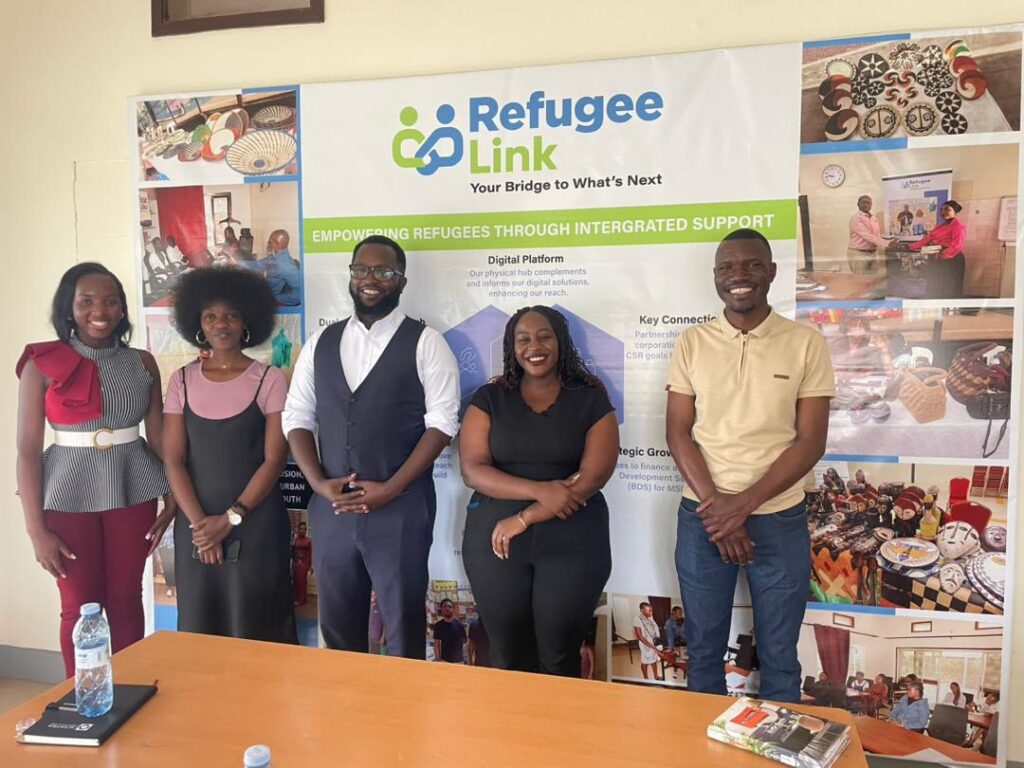
 On 24th April 2026, RefugeeLINK held a partnership exploration meeting at its premises with representatives from the Next Creator Programme to assess potential collaboration in supporting refugee and host community youth through creative, digital, and economic empowerment initiatives.
The discussion focused on aligning both organizations’ strengths to better support youth livelihoods, particularly within refugee communities. RefugeeLINK, also registered as Link4Refugee Solutions, was presented as a young social enterprise focused on livelihood inclusion, integration, and knowledge-sharing for refugees and host communities. Despite being only a few months into formal operations, the team highlighted over a decade of experience in refugee-focused programming. Operating from Rubaga, RefugeeLINK emphasized its strong community presence and focus on digital skilling, economic inclusion, and access to finance, with ongoing partnerships including Stanbic Business Incubator and ACCION.
The Next Creator Programme was introduced as a large-scale initiative developed with multiple partners, including the International Trade Centre, aimed at leveraging creative and cultural industries to generate income for young people. The programme targets youth, women, persons with disabilities, and refugees, with a structured training model of approximately 300 hours, certification pathways, and a strong focus on content creation and digital distribution. It also outlined ambitions to reach nearly 10,000 beneficiaries over three years, supported by a mix of grant and loan funding.
Strong alignment was identified between the two organizations, especially in reaching young refugee women and marginalized groups. RefugeeLINK’s strength in community access, trust, and mobilisation was seen as complementary to the programme’s technical expertise in content development and creative training.
Key considerations included accessibility for refugee participants, particularly transport, proximity, and the need for safe learning environments. The importance of safeguarding policies, inclusion frameworks, and child-friendly spaces was emphasized, alongside the need for RefugeeLINK to formalize and strengthen its internal documentation and governance systems.
The programme structure was discussed as a hybrid model combining physical and digital training, with centralized curriculum delivery and local outreach support. Content adaptation, including language translation and contextual relevance for refugee communities, was identified as essential for effective participation.
A Training of Trainers approach was also proposed, involving a short centralized training to align implementing partners on curriculum delivery and programme expectations.
The meeting concluded with agreement that this was an initial assessment phase, with both parties expressing strong interest in progressing towards formal collaboration. RefugeeLINK committed to preparing required documentation and strengthening internal policies, while the Next Creator Programme team would consolidate findings and plan the next stage of engagement, including deeper assessment and potential rollout planning.